


Research Articles
How Does the Brain Get Better at Solving New Problems?
Reviewed by: Brittany Taylor, Ph.D.
Published: September 2026
Reading time: ~3 min
As children get older, they get better at solving problems they have never seen before.
This ability, called fluid intelligence, is one of the most studied topics in brain science. But exactly how the brain changes to support that improvement has not been well understood in children and adolescents. A 2026 study from Boys Town National Research Hospital researchers, published in Imaging Neuroscience, used the largest sample to date to investigate how brain activity patterns supporting fluid reasoning develop during childhood.
What is fluid intelligence, and what does the brain have to do with it?
Fluid intelligence, sometimes abbreviated as Gf, is the ability to reason through new problems using logic, without relying on previously learned knowledge. Researchers have linked it to a specific network of brain regions called the P-FIT network, which stands for parieto-frontal integration theory. The P-FIT network includes regions in the parietal lobes and frontal lobes of the brain, and prior research has identified it as central to fluid reasoning.
How did the study work?
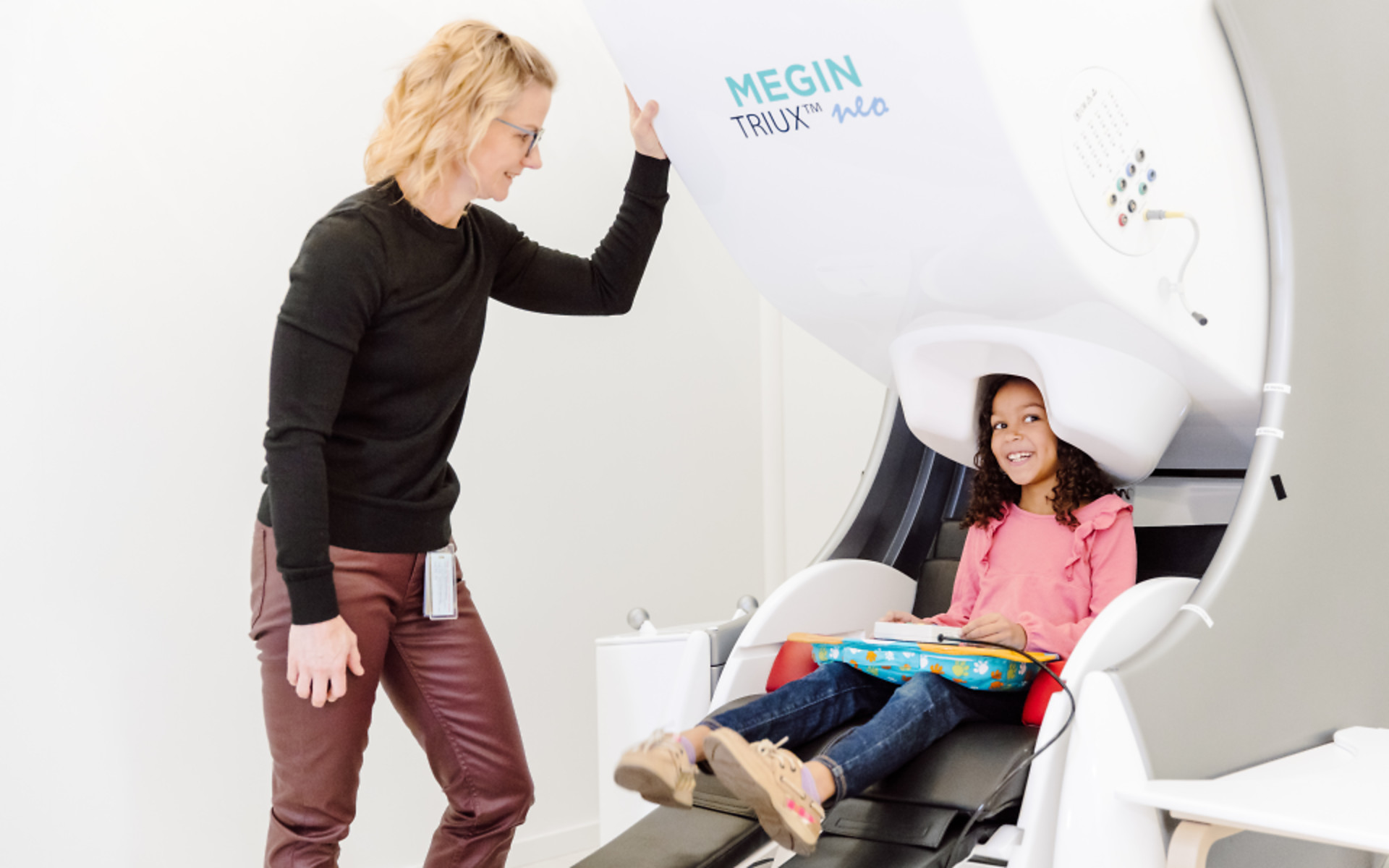
The team studied 104 youth between 8 and 15 years old. Each participant completed an abstract reasoning task during a magnetoencephalography (MEG) scan. MEG measures tiny magnetic signals produced by brain activity and can capture those signals millisecond by millisecond. Participants also completed behavioral assessments of matrix reasoning and vocabulary.
The researchers measured oscillatory dynamics, meaning the rhythmic patterns of brain activity, across the P-FIT network during the reasoning task, and then examined how those patterns related to age, sex and reasoning ability.
What did they find?
The study detected age- and sex-related differences in brain oscillations across multiple regions in the P-FIT network, including the superior temporal gyrus, the dorsolateral prefrontal cortex and the inferior frontal gyrus.
Most notably, changes in neural dynamics within the bilateral superior parietal lobules and the right lingual gyrus significantly mediated the relationship between age and improvements in fluid reasoning ability. In plain terms: the way brain activity in those specific regions changed with age helped explain why older children performed better on reasoning tasks.
The researchers stated that these findings are consistent with the P-FIT model of fluid intelligence and serve to clarify the neural dynamics that support the development of fluid reasoning.
Why is sample size significant here?
The paper noted that this study utilized the largest sample to date to investigate the development of these neural dynamics. Larger samples produce more reliable results, because findings are less likely to reflect chance patterns in a small group.
Want to read the research yourself?
Greenwood SL, Pulliam HR, Clarke-Smith MN, Rasmussen SC, Parolek GE, Smith OV, Taylor BK. "Frontoparietal oscillatory dynamics support the development of fluid reasoning in children and adolescents." Imaging Neuroscience, 2026.
Published Article
The article of record on the publisher's website. DOI: 10.1121/10.0042364|
PubMed
PubMed is the National Library of Medicine's index of biomedical research, where you can view this publication's citation and abstract.
PubMed Central
PubMed Central is the National Library of Medicine's free full-text archive, where you can read the complete article.