

Research happens behind the scenes, but its impact is deeply personal for families seeking the best possible care for their children.
Boys Town’s commitment to discovery goes back to our founder, Father Edward J. Flanagan, and his steadfast dedication to studying the problems children face, which continues today.
Last year, researchers across more than 40 labs on Boys Town’s campus produced measurable results and real-world advances for families in Omaha and around the world.
2025 Research by the Numbers
- Publications: 143+ peer-reviewed studies.
- These studies advance knowledge and translate evidence into proven approaches for clinicians, educators and families.
- Patents: 20 new research patents filed.
- Moving promising ideas from lab to practice makes it possible to develop new tools, technologies and treatments.
- Funding: 72 funding proposals submitted with a 33% success rate – nearly three times the national average for National Institutes of Health scientists.
- The ability to secure competitive funding reflects the strength of research at Boys Town.
- Presentations: All 42 Boys Town scientists and 8 postdoctoral fellows presented at U.S. conferences, with 22 scientists and 6 postdoctoral fellows also presenting internationally.
- As thought leaders on the national and global research stage, Boys Town researchers are committed to sharing findings, advancing collaboration and accelerating progress for children everywhere.
2025 Research Study Highlights
Hearing-Aid Fitting for Children
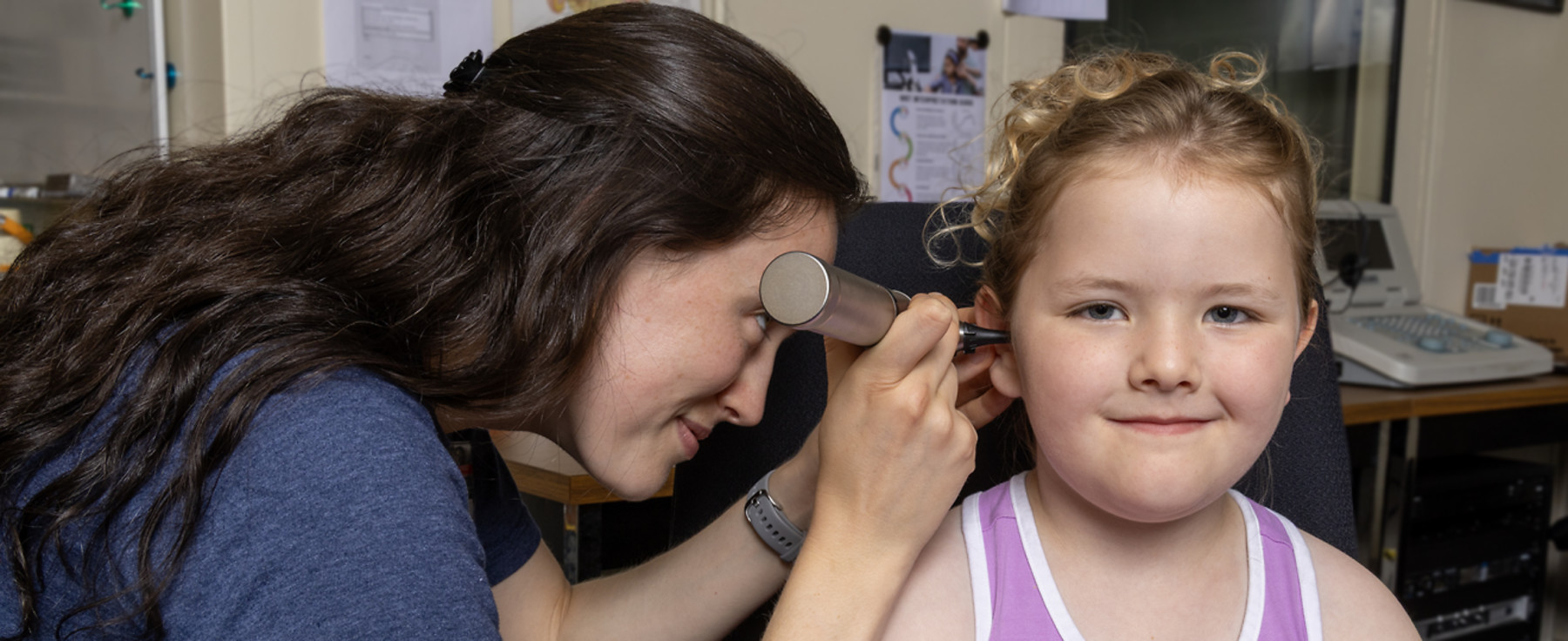
Boys Town’s innovative work to improve the hearing-aid fitting process received a boost by winning the 2025 Amazon Web Services (AWS) Imagine Grant. Custom molds are critical because a poor fit can cause feedback or whistling and reduce hearing access.
This grant will support Boys Town’s efforts to predict ear canal growth through a machine learning model. Generative AI with 3D printing technology will help make it possible to create custom hearing-aid earmolds with fewer in-person visits and often uncomfortable ear impressions.
Early Hearing Loss in People with Down Syndrome
Dr. Heather Porter’s research found that many people with Down syndrome have hearing patterns in their teens and 20s that are more typically seen in adults in the general population around age 60.
Her project has recruited more than 200 study participants — far more than previous studies — to improve hearing and balance outcomes in people with Down syndrome over a wide age range. Boys Town now has three separate grants and more than $5 million in external funding.
Parental Trauma and Children’s Language Development
Dr. Claire Selin designed a study to test whether a parent’s history of childhood adversity may predict the child’s communication to a greater extent than the child’s own history of adversity. The argument was so compelling, Dr. Selin’s proposal was funded on the first submission.
Studying the impact of intergenerational trauma on communication outcomes in children may lead to ways to identify at-risk families earlier, so intervention can begin before communication problems emerge.
Long-Term Impact of Inpatient Psychiatric Care
Dr. Patrick Tyler, Senior Director of the Child and Family Translational Research Center, and his team are gathering data on specific mental health indicators — such as decreases in hopelessness and increases in social support — to study how specialized inpatient psychiatric care helps in the long term.
Key to the research is the collaboration of researchers and clinicians, a scientific approach that has always guided Boys Town’s array of services, including the now 50-year-old Teaching-Family model.
Puberty, Depression and Anxiety in Adolescents with Autism
Dr. Giorgia Picci is one of few researchers studying puberty and neurodevelopment in autistic youth. Her study examines mental health, brain imaging and hormonal markers of puberty in adolescents with autism to better understand how pubertal changes shape brain development and well-being.
Supported by a Young Investigator Grant from the Brain Behavior Research Foundation, this work may help identify developmental risk factors for anxiety and depression in autistic teens and ultimately inform targeted intervention efforts.
State-of-the-Art Infant Brain Mapping
Boys Town researchers at our Institute for Human Neuroscience (IHN) are mapping the infant brain in ways never before possible, thanks to a device called the OPM (optically pumped magnetometer). Boys Town was one of the first facilities in the world to install the system, which shows how the infant brain works in real time by capturing the brain’s magnetic signals.
This one-of-a-kind approach will allow us to do brain mapping in infants with epilepsy and other neurodevelopmental conditions — groundbreaking work that may lead to better understanding of the brain and these conditions. Designed by scientists for scientists, the IHN uses the field’s most advanced noninvasive neuroimaging tools to propel discovery and innovation.
Remote Screening for Early Language Development
An AI‑powered tool being developed at Boys Town will allow a parent to upload a smartphone recording of a child speaking. The program will then analyze the child’s speech and recommend whether the parent should talk to their pediatrician about their child’s language development.
Adaptive Training for Stronger Social Skills
Data from the Social Skills Assessment taken by Boys Town youth is being used to develop adaptive training modules that address their specific needs. The AI tool will help target and strengthen the foundational skills used for the Boys Town model by adapting modules to the youths’ individual needs.
2026 and Beyond
At Boys Town, research remains central to our mission of changing the way America cares for children in body, mind and spirit.
In 2025, a 254,000-square-foot expansion of Boys Town National Research Hospital began, including the Dr. Wayne L. Ryan Clinic and Research Center, made possible by a $300 million gift from The Ryan Foundation.
When it opens in 2027, the new space will bring researchers and clinicians closer together — ensuring advances move quickly from the lab to the children and families who need them.