

Children who wear hearing aids often fall behind in language and school. Yet some do as well or even better than peers with typical hearing. Why the difference?
The answer may lie in what happens in the brain split seconds before decisions are made.
Boys Town neuroscientist Elizabeth Heinrichs-Graham, Ph.D., is studying that critical moment using the most advanced brain imaging tools in the world.
“We have technology that only a handful of people are using for research,” she said. “We are discovering as the world discovers.”
Her research will look at differences in how the brain processes information in those split seconds for kids who wear hearing aids versus those with typical hearing.
It’s groundbreaking work happening right here in Nebraska, and it may help all children.
Using Space Age Imaging
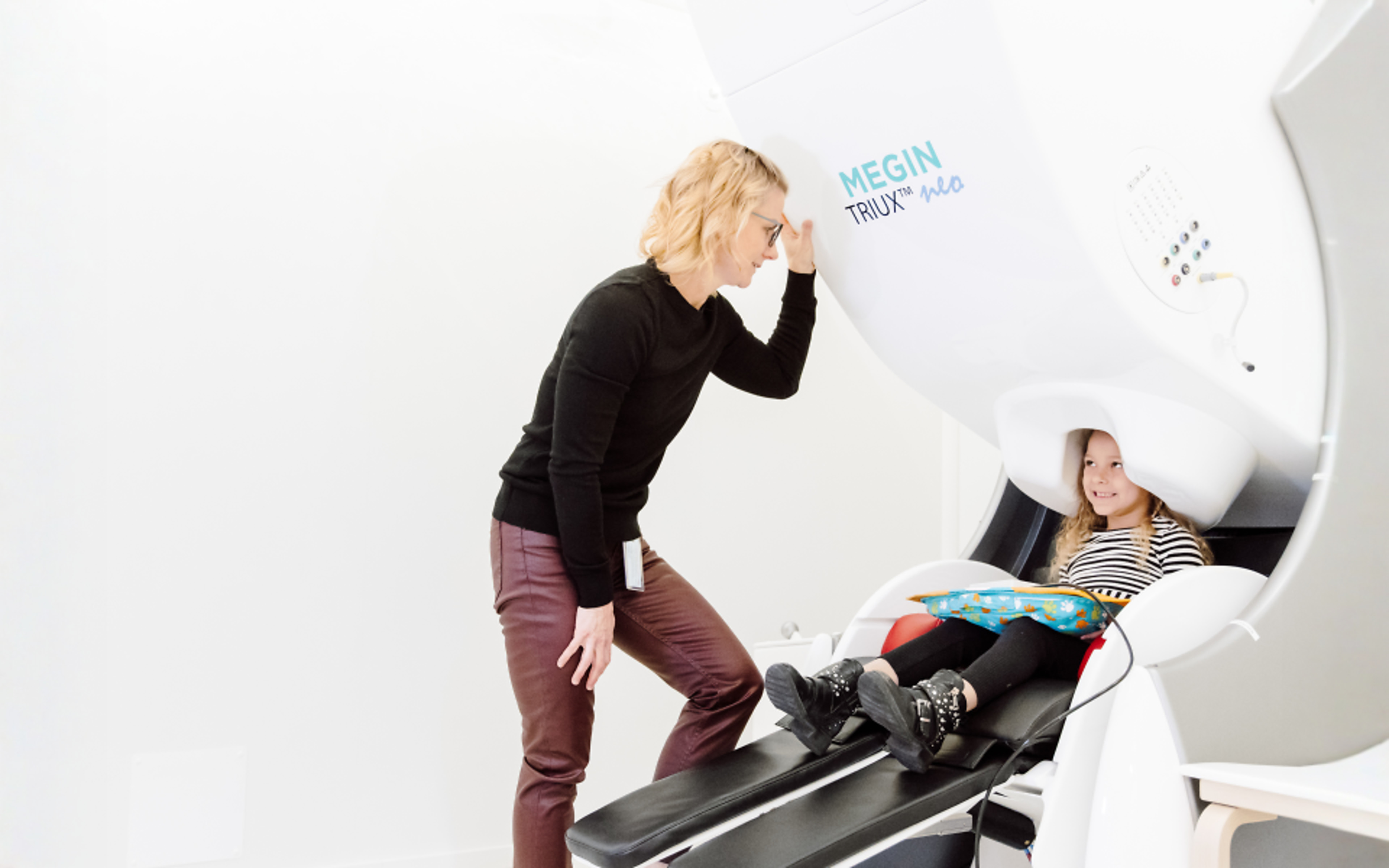
Imagine a machine that reveals how you think by showing the brain working in real time. Boys Town’s team of neuroimaging scientists are some of the world’s best at using imaging technology that does exactly that.
It’s called a high-resolution MEG — short for magnetoencephalography.
This high-tech marvel makes now an exciting time for brain researchers like Dr. Heinrichs-Graham, director of the Cognitive and Sensory Imaging Laboratory at Boys Town National Research Hospital.
“I can look at the brain and what it's doing from the time we ask you to do something up until the point that you make a decision,” she said.
That’s key because researchers have found that children with hearing loss make decisions much like other kids. Where they may differ is in how they process stimuli during that split second.
“We’re hoping to get at which part of the process is breaking down as a child is having difficulty with language development, for example,” she said.
Working Together to Unlock Mysteries
This work depends on families who volunteer to help. Dr. Heinrichs-Graham is currently recruiting participants for the five-year study.
“We are so appreciative of the families who are willing to be part of this really exciting adventure,” she said.
Children in the study are asked to play some games or solve puzzles with study staff, listen to, watch, or respond to different stimuli during the MEG scan, take a hearing test, and have an MRI scan. Parents share information via questionnaires.
Dr. Heinrichs-Graham and a group of audiology and language scientists at Boys Town will review the data.
“We have researchers with different expertise coming together to answer really important questions that we all agree should be answered,” she said.
Shaping the Future of Learning
Hearing loss is central to the research, but the focus is on how the brain adapts to widely varying experiences — because every child is different.
“The brain is an incredibly adaptive organ,” Dr. Heinrichs-Graham said. “Everybody is a superhero when you think about it, because the brain can change in all these really miraculous ways.”
Ultimately, the goal is to understand how children with hearing differences sense their environment as they make decisions — and if that can predict how they learn.
“If we can understand how these experiences shape the brain, we can help every child get what they need to succeed—academically and in life,” Dr. Heinrichs-Graham said.