More hope is on the horizon for Alzheimer’s disease. Researchers are making progress for a condition long defined by fear and uncertainty.
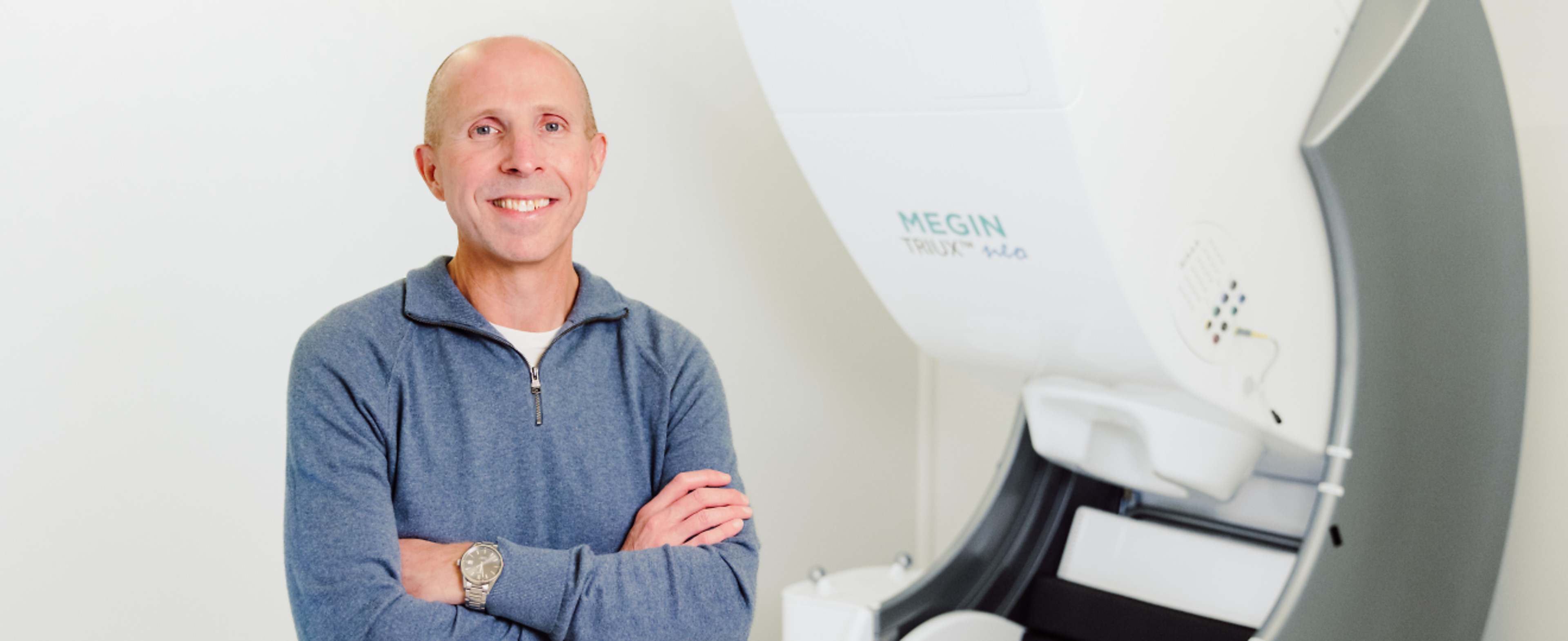
“Just a few years ago, there was no real treatment,” said Tony W. Wilson, Ph.D., director of the Institute for Human Neuroscience at Boys Town National Research Hospital.
“Now, if Alzheimer’s is diagnosed early, a lot can be done to slow it down and give families more good years.”
According to Dr. Wilson, rapid research advances since 2023 have produced:
- An FDA-approved blood test that can diagnose the disease.
- A treatment that can slow the disease by 35 to 40 percent.
- More promising medications now in clinical trials.
That’s a welcome step forward for more than 7 million individuals in the U.S. living with Alzheimer’s.
“Finally, we’ve reached the moment things can change,” Dr. Wilson said. “That’s good news, made possible by research.”
Unlocking Answers
Some of that research is happening right here at Boys Town’s Institute for Human Neuroscience.
As director of the Institute and the Dynamic Imaging of Cognition and Neuromodulation (DICoN) Laboratory, Dr. Wilson is leading a multi-stage study called Dynamic Mapping of Alzheimer’s Pathology.
“Overall, our current goal is to identify markers of the disease as early as possible,” he said. “Because the earlier you identify Alzheimer's, the better the treatment works.” The new treatments greatly slow down the disease, but they don’t reverse the damage already done.
A big question is how early can the disease be detected.
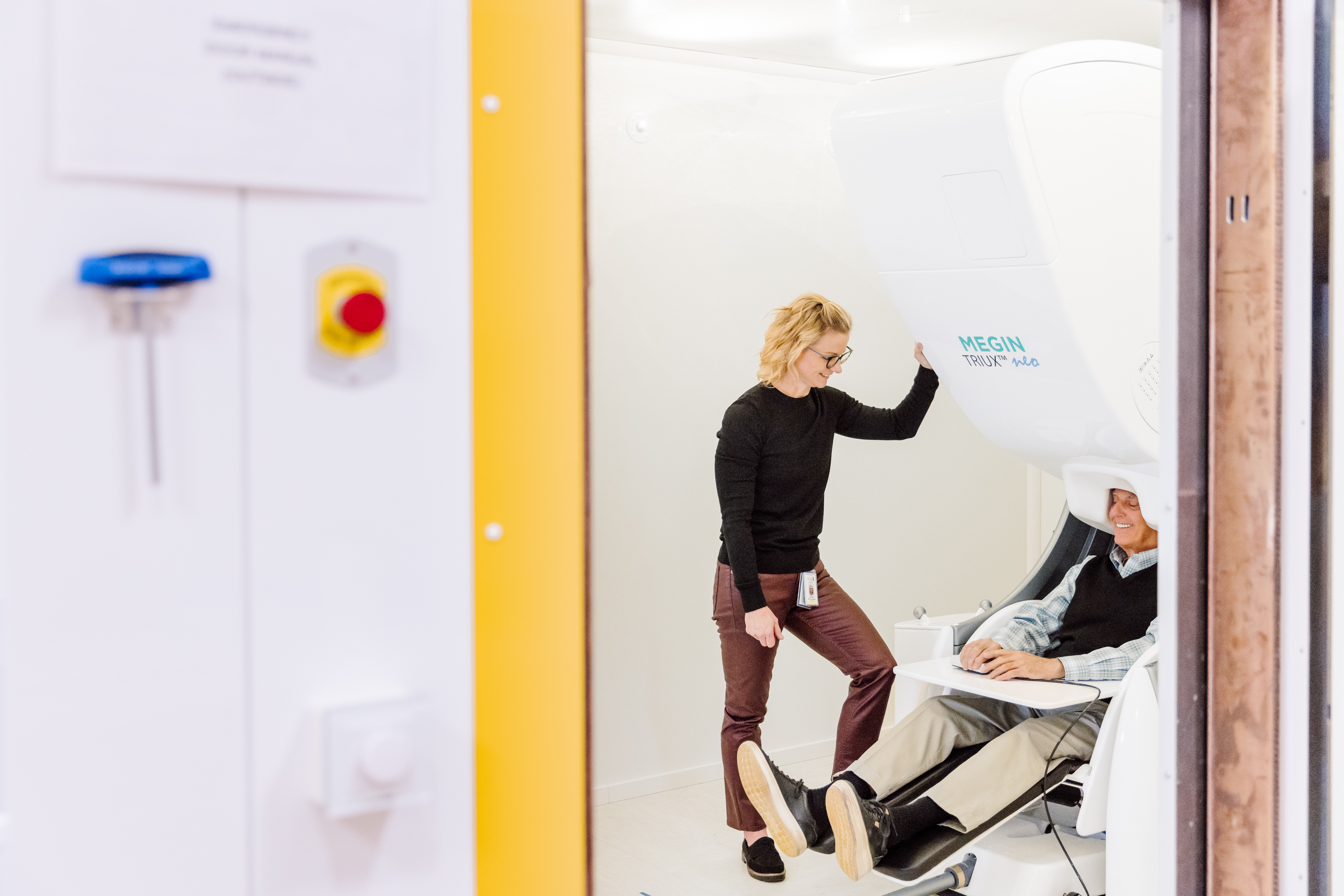
To find out, Boys Town researchers are using one of the world’s most advanced brain imaging tools — the MEG, which is short for magnetoencephalography.
With it, Dr. Wilson’s team can map exactly where protein deposits associated with Alzheimer’s are disrupting the brain signals needed for cognition.
“We’re looking for a marker that is definitive for Alzheimer’s,” Dr. Wilson said. “The MEG provides a critical picture.”
Stepping Forward
Research like this depends on the willingness of people to take part.
“If not for the volunteers we had five and 10 years ago, we wouldn’t have the treatment we have today,” Dr. Wilson said. “That’s how research advances.”
His current study is seeking participants who are:
- 55 years or older
- Diagnosed with Alzheimer’s or mild cognitive impairment, or have early signs of cognitive decline
- Fluent English speakers
The study starts with a questionnaire, a short cognitive assessment and a blood test that detects proteins linked to Alzheimer’s disease. Those who qualify then go on to complete:
- Cognitive and lifestyle questionnaires
- Non‑invasive MEG and MRI scans
- Blood draw
- PET/CT scan, if not previously done
The entire process includes three to four in-person visits, each lasting up to four hours. That’s time well spent, according to Dr. Wilson.
Participants receive blood test results and those who qualify for the full study receive gold standard tests and diagnostic reports, as well as consultation on possible next steps in their medical care. And, he said, “When you volunteer today you are helping future generations.”
Improving Tomorrow
Knowledge is power for those worried about Alzheimer’s.
“It’s something families think about all the time,” said Dr. Wilson. Even small slips — forgetting a name or misplacing an item — can feed that concern.
While many assume genetics are the biggest risk factor, research has revealed that stress and poor sleep can also play a role.
Discoveries like these can take years, even decades. That’s why the pace of recent advances feels especially hopeful.
“The observable progress in identifying and treating Alzheimer’s disease is an emerging success story for science,” Dr. Wilson said. “The future is going to be very different.”